


 Cart
Cart
 sales@molnova.com


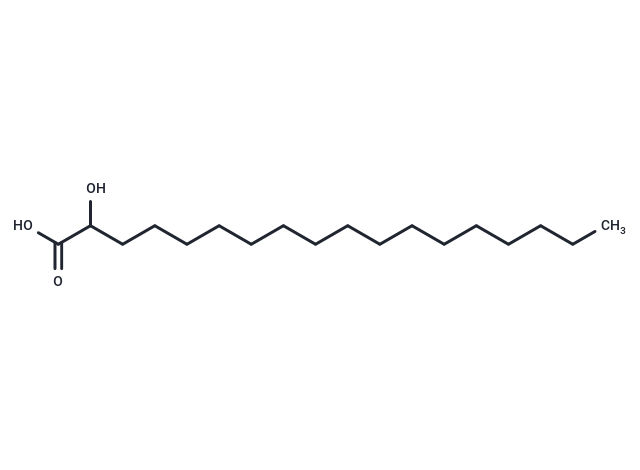
2-Hydroxystearic acid
CAS No. 629-22-1
2-Hydroxystearic acid( —— )
Catalog No. M34780 CAS No. 629-22-1
2-Hydroxystearic acid is a hydroxy fatty acid found in humans and U. armoricana. It reduces the growth of Ehrlich ascites tumor (EAT) cells in vitro when used at a concentration of 100 μM.
Purity : >98% (HPLC)
 COA
Datasheet
HNMR
HPLC
MSDS
Handing Instructions
COA
Datasheet
HNMR
HPLC
MSDS
Handing Instructions
| Size | Price / USD | Stock | Quantity |
| 2MG | 46 | In Stock |


|
| 5MG | 54 | In Stock |
|
| 10MG | 77 | In Stock |
|
| 25MG | 178 | In Stock |
|
| 50MG | 266 | In Stock |
|
| 100MG | 390 | In Stock |
|
| 500MG | 888 | In Stock |
|
| 1G | Get Quote | In Stock |
|
Biological Information
-
Product Name2-Hydroxystearic acid
-
NoteResearch use only, not for human use.
-
Brief Description2-Hydroxystearic acid is a hydroxy fatty acid found in humans and U. armoricana. It reduces the growth of Ehrlich ascites tumor (EAT) cells in vitro when used at a concentration of 100 μM.
-
DescriptionDL-alpha-Hydroxystearic acid is a biochemical reagent that can be used as a biological material or organic compound for life science related research.
-
In Vitro——
-
In Vivo——
-
Synonyms——
-
PathwayOthers
-
TargetOther Targets
-
RecptorOthers
-
Research Area——
-
Indication——
Chemical Information
-
CAS Number629-22-1
-
Formula Weight300.48
-
Molecular FormulaC18H36O3
-
Purity>98% (HPLC)
-
Solubility——
-
SMILESC(CCC(C(O)=O)O)CCCCCCCCCCCCC
-
Chemical Name——
Shipping & Storage Information
-
Storage(-20℃)
-
ShippingWith Ice Pack
-
Stability≥ 2 years
Reference
molnova catalog



related products
-
Xanthosine dihydrate
Xanthosine is produced by guanine-free mutants of bacteria e.g. Bacillus subtilis Aerobacter aerogenes. Xanthosine monophosphate is an intermediate in purine metabolism formed from IMP and forming GMP.
-
Ganoderic acid GS-1
Ganoderic acid GS-1, a highly oxygenated lanostane-type triterpenoid, has anti-HIV-1 protease activities with an IC 50 of 58 μM.
-
3,5-Dimethoxytoluene
3,5-Dimethoxytoluene (Orcinol dimethyl ether), the main fragrance component in roses, has a sedative effect and can be used as a pest attractant.
